Looking Beyond India’s Borders
The Kotak Quality Overseas Equity Omni FoF arrives at a defining moment for Indian investors. India’s equity markets have delivered exceptional wealth creation over the past two decades. The Nifty 50 has compounded at impressive rates. The structural tailwinds remain firmly intact — a young population, rapid digitalisation, rising consumption, and expanding financial inclusion. For any Indian investor, the domestic story is compelling.
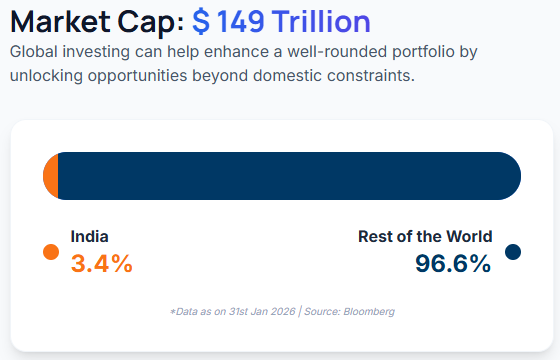
And yet, a hard arithmetic reality demands attention. India’s listed equity market represents just 3.4% of global market capitalisation as of January 2026. The remaining 96.6% — the companies designing your smartphone chips, developing next-generation cancer therapies, and building the cloud infrastructure powering the digital economy — sits entirely outside a purely domestic portfolio.
This is the core challenge that every serious Indian investor must address. Building a resilient portfolio in the twenty-first century is no longer a domestic exercise. It is a global one.
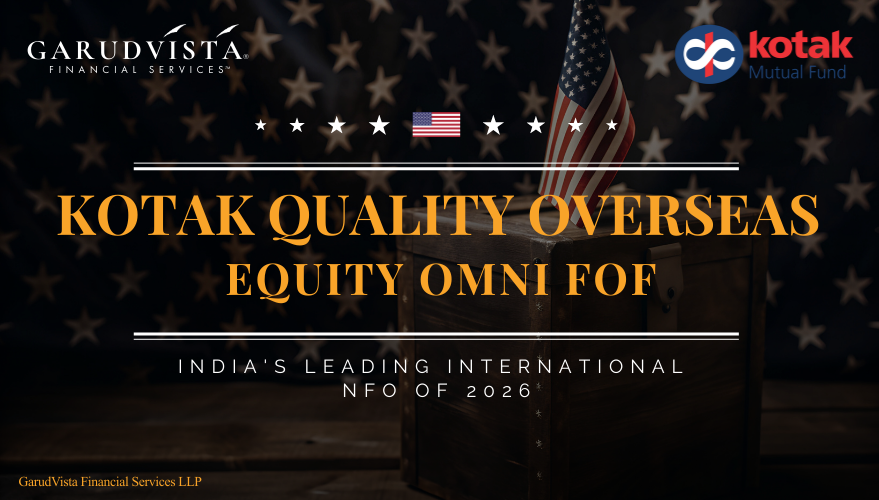
Consequently, Kotak Mahindra Asset Management Company has launched this NFO — open from March 6 to March 20, 2026. The fund is not merely another international mutual fund . It is a structured gateway: one INR-denominated investment that connects Indian investors directly to the GMO Quality Investment Fund, a $7.8 billion global equity portfolio managed by GMO LLC of Boston.
What This Kotak Overseas Equity Fund Guide Covers
This guide provides a thorough, analytical examination of the Kotak Overseas Equity Fund. Specifically, it covers the fund’s design, investment philosophy, portfolio characteristics, historical performance, macro rationale, risks, and the ideal investor profile. Read each section to build a complete picture before making any investment decision.
Section I: Why Global Diversification Is No Longer Optional
The Home Bias Problem
Behavioral finance has extensively documented “home bias.” Simply put, it is the tendency of investors everywhere to over-allocate savings to domestic assets. For Indian investors, this bias is understandable. Domestic returns have often been strong. In addition, the regulatory environment for foreign investing has been evolving. Moreover, the complexity of international investing has made staying domestic the easier choice.
However, the cost of unchecked home bias is serious. It is not just an opportunity cost — it is a structural weakness. A portfolio fully exposed to one country’s economic cycle, monetary policy, and political risk is far more fragile than it appears. When Indian equities sell off — whether driven by a monsoon failure, a credit crisis, or a geopolitical shock — all domestic holdings fall at the same time. As a result, the correlation between Indian asset classes rises precisely when diversification matters most.
Why Developed Markets Offer True Diversification
Global equity allocation, particularly to developed markets, acts as a genuine diversifier. The economic cycles of the United States, Europe, and Japan do not move in sync with India’s cycle. For instance, when India faces a difficult macro environment, the US technology sector might accelerate due to AI adoption. Similarly, when European pharmaceutical companies generate strong cash flows, Indian financials might navigate a credit stress period. Therefore, this non-correlation is the engine of true portfolio resilience.
The Scale of the Missed Opportunity
To appreciate the global opportunity, consider the numbers. The combined market capitalisation of the global equity universe stands at approximately $149 trillion as of early 2026. The United States alone accounts for roughly 62–65%, representing about $90 trillion in listed corporate wealth. Europe contributes another 15–17%. Developed Asia adds a further 10–12%. India’s share, despite its strong trajectory, is just over 3%.
Within these international markets sit the companies defining the global economy. Microsoft builds the AI era through Azure. Alphabet’s advertising ecosystem generates cash flows that rival national economies. Apple has created the most powerful consumer platform in history. TSMC manufactures the chips that make the digital world run. Johnson & Johnson spans the most critical areas of human healthcare. None of these companies appear in any domestic Indian mutual fund . An investor holding only Nifty 50 stocks has zero exposure to any of them. The Kotak Overseas Equity Fund specifically corrects this gap.
Currency as a Structural Tailwind
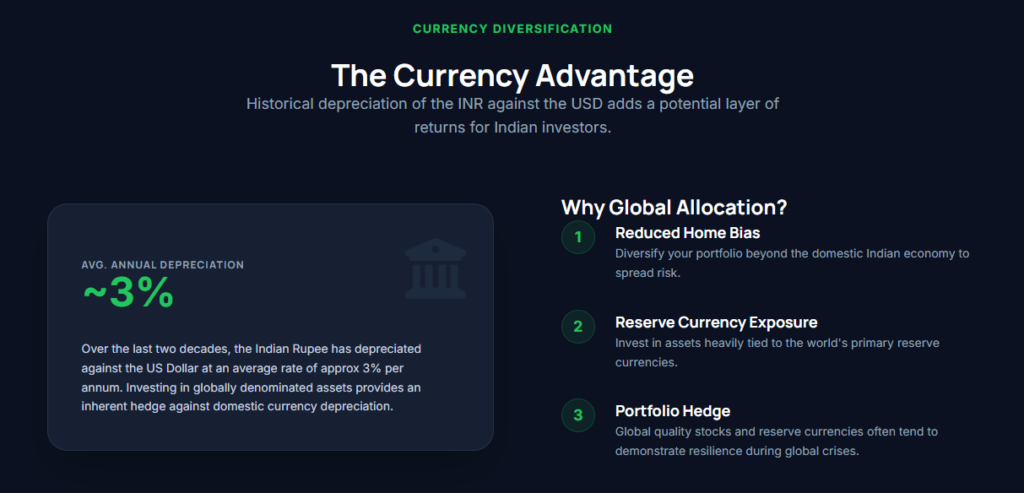
Beyond equity diversification, there is an important currency dimension. Over the past two decades, the Indian Rupee has depreciated against the US Dollar at an average rate of approximately 3% per annum. This reflects structural differences in inflation and interest rates between India and the US — a mathematical reality, not a criticism of India’s management.
For Indian investors holding globally denominated assets, this trend adds a passive return boost. For example, if the GMO Quality Investment Fund delivers 14% annualised in USD terms, Indian investors historically benefit from an additional ~3% per annum as the Rupee gradually erodes. Over long horizons, therefore, this compounding effect is meaningful and should not be underestimated.
That said, currency movements are unpredictable in the short term. A stronger Rupee environment would reduce INR-denominated returns relative to USD returns. As a result, investors must price this two-way risk honestly and maintain a long-term perspective.
Discover More About This Fund : Click Here
Section II: How the Kotak Overseas Equity Fund Structure Works
What Is a Fund of Funds (FoF)?
Before examining the Kotak scheme, it helps to understand the Fund of Funds structure. This mechanism is central to how the investment works. It also carries specific implications for cost, taxation, and efficiency.
A Fund of Fund scheme is a mutual fund that allocates its corpus to units of other funds — rather than buying individual stocks or bonds directly. If you are new to mutual fund investing in India, understanding this structure is the essential first step before evaluating any FoF. In the Kotak Overseas Equity Fund’s case, the structure works simply. An Indian investor subscribes in Indian Rupees. Kotak Mahindra AMC then deploys 95–100% of that corpus into the GMO Quality Investment Fund, which is domiciled outside India. The GMO fund then buys shares of individual global companies directly.
Why the FoF Route Exists
The FoF structure serves an important regulatory purpose. Direct foreign equity ownership by Indian investors faces constraints under RBI and SEBI regulations governing the Liberalised Remittance Scheme (LRS). The FoF route, by contrast, allows a SEBI-registered Indian mutual fund to invest in overseas fund units within SEBI’s aggregate industry limits. As a result, this route is cleaner, more efficient, and far more accessible for retail investors seeking international equity exposure.
The Gateway Architecture: Three Clear Tiers
The investment journey operates across three tiers. Tier 1 — The Indian Investor subscribes in INR, starting at ₹1,000. Tier 2 — Kotak Quality Overseas Equity Omni FoF allocates 95–100% of assets to the underlying international fund. Kotak AMC handles fund selection, monitoring, due diligence, and INR-USD conversion mechanics. Tier 3 — GMO Quality Investment Fund makes all stock selection decisions. Portfolio managers Tom Hancock, Ty Cobb CFA, and Anthony Hene apply GMO’s Quality framework to identify the world’s best businesses.
The result is elegant. An Indian investor writing a cheque of ₹1,000 effectively becomes a beneficial owner of a portfolio including Microsoft, Alphabet, Apple, and Johnson & Johnson — through a single, regulated, INR-denominated investment.
Discover More About This Fund : Click Here
Section III: GMO — The Investment Manager Behind the Fund
Who Is GMO?
For many Indian investors, GMO LLC may not be a familiar name. However, in institutional investment management, GMO holds a uniquely respected position. Jeremy Grantham, Richard Mayo, and Eyk van Otterloo founded the firm in Boston in 1977. Today, GMO manages approximately $60–70 billion globally across equity, fixed income, alternatives, and multi-asset portfolios. Its clients include some of the world’s largest sovereign wealth funds, pension funds, endowments, and foundations — institutions that conduct the most rigorous due diligence in finance. That they trust GMO with significant capital speaks directly to the firm’s track record and intellectual rigour.
GMO’s Reputation for Prescient Analysis
GMO has built its reputation through two notable achievements. First, its research-driven approach famously led the firm to warn clients about the dot-com bubble in the late 1990s — years before it burst. Similarly, GMO flagged the credit excesses that preceded the 2008 financial crisis well in advance. Second, and equally important, its quantitative yet fundamentally grounded equity process produced the Quality Investment strategy that underlies the Kotak Overseas Equity Fund.
The Portfolio Management Team
The team behind the GMO Quality Investment Fund brings extraordinary depth and continuity. Tom Hancock holds a PhD from Harvard University and has led the quality strategy since joining GMO in 1995 — three full decades. Ty Cobb, CFA, joined in 1997, bringing strong financial analysis skills. Anthony Hene, who holds a Master’s from the University of Oxford, has also been with the firm since 1995. Together, therefore, this team has a combined tenure of nearly 90 years at a single firm. That level of consistency is extraordinarily rare in asset management and deeply reassuring for long-term investors.
GMO’s Quality Philosophy: Three Pillars
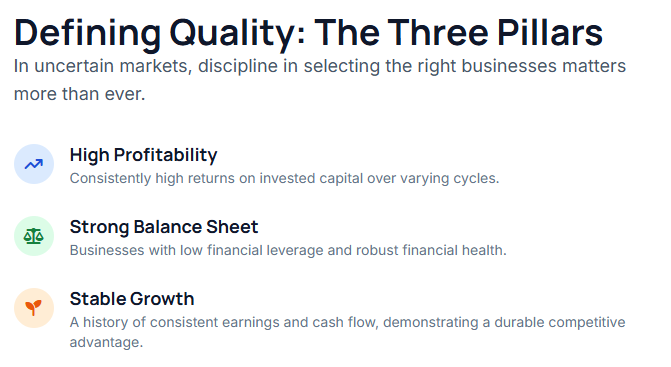
The term “quality investing” appears across many mutual fund marketing materials. GMO’s definition, however, is specific, measurable, and historically validated. The firm targets companies that demonstrate three distinct characteristics.
First Pillar — High Profitability: Quality companies generate consistently high returns on invested capital (ROIC) across varying economic cycles. ROIC measures profits relative to the capital a business deploys. A high ROIC company has demonstrated durable competitive advantage, real pricing power, and disciplined capital allocation. Furthermore, high ROIC is the single most reliable predictor of sustained shareholder value creation over time.
Second Pillar — Strong Balance Sheet: GMO emphasises low financial leverage and robust financial health. Companies with strong balance sheets — high cash, manageable debt, conservative financing — retain strategic flexibility. They invest through downturns, acquire competitors at low prices, return capital to shareholders, and survive economic shocks. In contrast, heavily leveraged businesses struggle or fail when conditions tighten.
Third Pillar — Stable Growth: Quality companies show a consistent history of earnings and cash flow growth. This reflects a durable competitive advantage — what Warren Buffett calls an economic “moat.” Stability here does not mean stagnation. Rather, it means earnings do not depend on a single product cycle, commodity price, or economic boom. Predictable cash flows enable more reliable long-term compounding.
Importantly, GMO does not assess these pillars qualitatively. Instead, the firm applies quantitative screening across its global stock universe, identifies companies scoring highest on all three dimensions, and ranks them accordingly. As a result, the final portfolio sits at the very top of the global quality distribution.
Section IV: Inside the Portfolio — What You Are Actually Buying
The Top Ten Holdings
The GMO Quality Investment Fund’s top ten holdings, as of January 31, 2026, represent a snapshot of the world’s most financially formidable corporations. Understanding each holding provides genuine insight into the quality strategy.
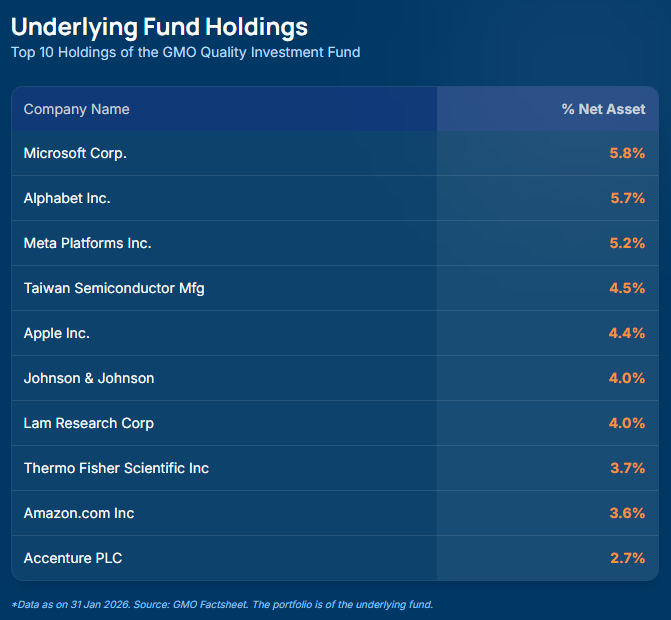
Microsoft Corporation (5.8%) holds the top position. The company has transformed from a legacy software firm into the dominant force in cloud computing and AI infrastructure. Its Azure platform competes directly with Amazon Web Services and Google Cloud. Furthermore, its partnership with OpenAI places it at the centre of the most important technology shift since the internet. Microsoft generates over $60 billion in free cash flow annually, carries a pristine balance sheet, and has compounded revenue at double-digit rates through multiple economic cycles.
Alphabet Inc. (5.7%) is the parent company of Google. Google commands over 90% global search market share. Alphabet also operates YouTube, Google Cloud, and Waymo — the autonomous vehicle platform. Its advertising business generates cash flows that fund one of the largest R&D programmes in corporate history.
Meta Platforms Inc. (5.2%) controls the world’s largest social media ecosystem. Facebook, Instagram, WhatsApp, and Threads together reach nearly 3.5 billion monthly active users — approximately half the planet. After a painful metaverse investment phase, Meta refocused its capital allocation with strong discipline. The company now generates over $50 billion in free cash flow annually. Moreover, its AI-powered advertising tools have significantly boosted revenue per user.
Taiwan Semiconductor Manufacturing Company (4.5%) manufactures the advanced chips that make the modern digital economy function. TSMC produces Apple’s iPhone chips, NVIDIA’s AI accelerators, and AMD’s data centre processors. Its lead in advanced 3-nanometre fabrication constitutes one of the most formidable competitive moats in global industry. Consequently, no competitor currently comes close to replicating its capabilities.
Apple Inc. (4.4%) needs little introduction to Indian investors. Its hardware design, deep software integration, and growing services business — App Store, Apple Music, Apple TV+, iCloud — have built one of the most powerful consumer ecosystems ever created. The services segment alone now generates over $100 billion annually. Notably, its margins significantly exceed those of the hardware business.
Johnson & Johnson (4.0%) provides the portfolio’s healthcare defensive component. It has paid uninterrupted dividends for over six decades. Its pharmaceutical products and MedTech devices generate stable, predictable cash flows that remain largely insulated from economic cycles.
Discover More About This Fund : Click Here
Sector Allocation: Where the Portfolio Concentrates
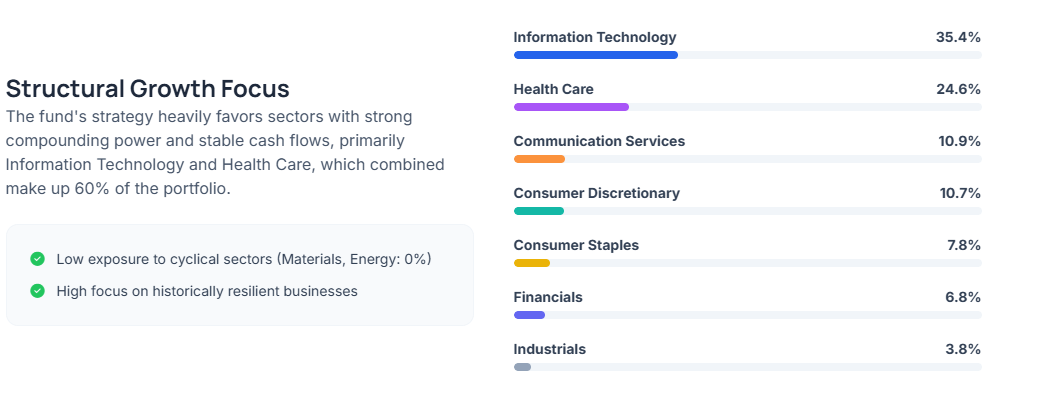
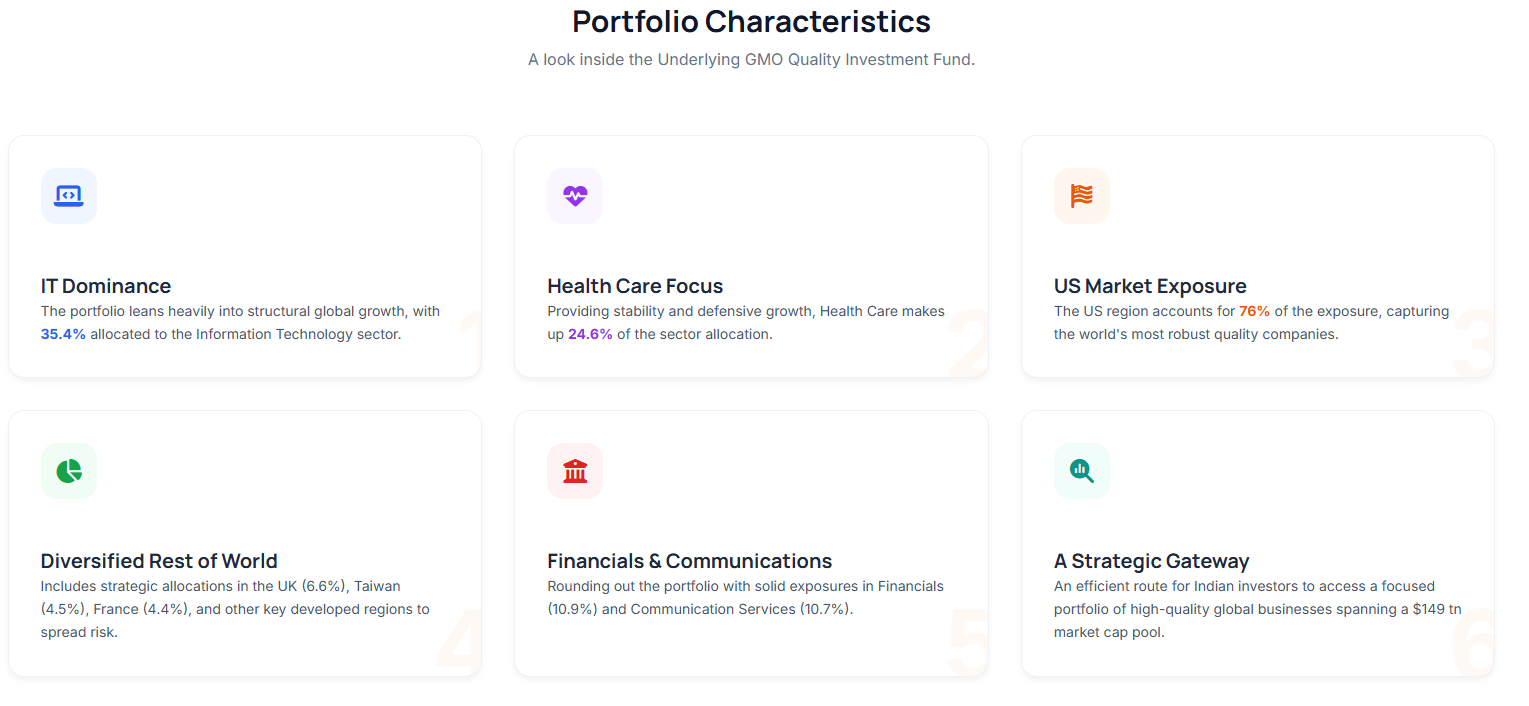
The GMO fund’s sector allocation reflects a clear philosophical stance. Information Technology commands the largest allocation at 35.4%. This reflects the managers’ conviction that technology companies — especially those with dominant platforms, recurring revenue, and strong network effects — offer the best concentration of quality characteristics globally. The IT allocation spans semiconductors (TSMC, Lam Research), enterprise software (Microsoft, Accenture), and consumer technology (Apple).
Health Care follows at 24.6%. This provides a defensive counterbalance to growth-oriented technology holdings. Healthcare cash flows tend to be insensitive to economic cycles. Human health needs do not decline in recessions. Communication Services at 10.9% captures Alphabet and Meta. Consumer Discretionary at 10.7% includes Amazon. Consumer Staples at 7.8% adds further defensiveness. Financials at 6.8% and Industrials at 3.8% round out the portfolio.
Notably, the portfolio has zero allocation to Materials and Energy. This is a deliberate, historically consistent choice. GMO’s research shows that commodity-intensive businesses rarely generate durable returns on capital over full market cycles.
Geographic Exposure: Developed Markets First
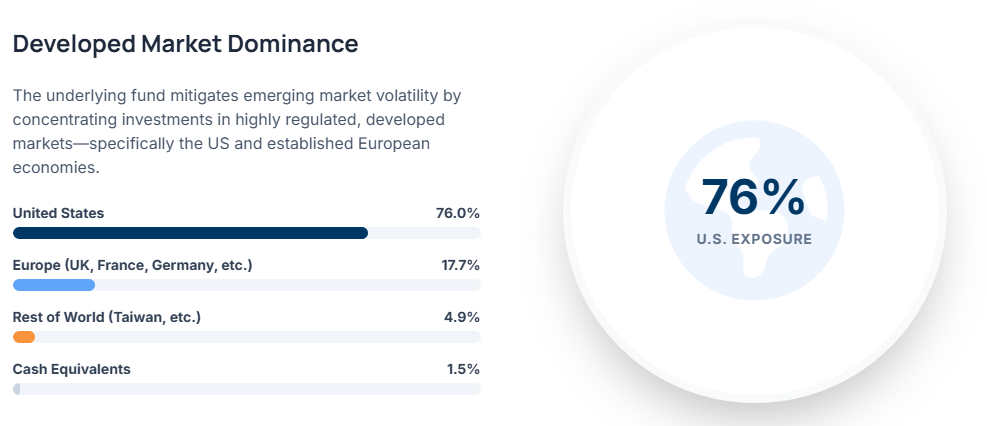
The United States accounts for 76% of the portfolio. This reflects the overwhelming concentration of quality companies in US markets. The US equity market is not simply the world’s largest. It is also home to the highest density of businesses that combine high ROIC, strong balance sheets, and stable earnings growth. Europe accounts for approximately 17.7%, with significant allocations in the UK (6.6%), France (4.4%), and Germany. The Rest of World, including Taiwan, makes up 4.9%, with 1.5% in cash equivalents.
The deliberate underweight to emerging markets — including India — reflects GMO’s quality screens. Many emerging market companies face higher business volatility, governance variability, and financial leverage. As a result, fewer meet GMO’s strict quality thresholds.
Section V: Performance — What the Track Record Shows
Long-Term Outperformance Across Time Horizons
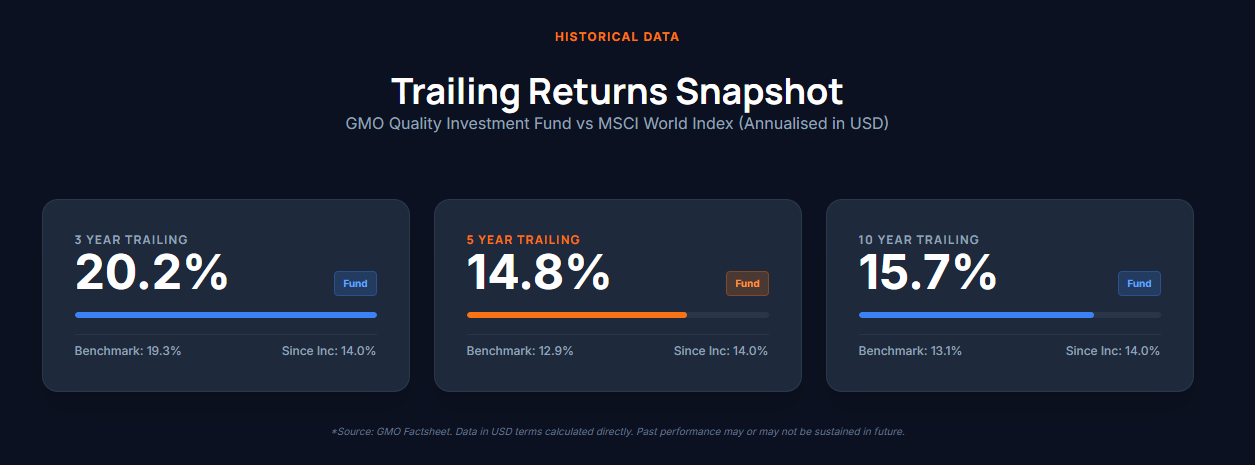
The GMO Quality Investment Fund has generated meaningful outperformance against its benchmark — the MSCI World Index — across every major time horizon. Past performance does not guarantee future results. That caveat is essential. However, a 15-year live track record across a wide variety of market environments provides genuine insight into the strategy’s soundness.
Over the 3-year trailing period, the GMO fund delivered 20.2% annualised returns in USD terms. The MSCI World benchmark returned 19.3% over the same period. This represents an alpha of approximately 90 basis points. That outperformance came during aggressive rate hikes, geopolitical turmoil, and significant market volatility.
Over five years, the fund generated 14.8% annualised returns in USD. The benchmark returned 12.9%. Consequently, the fund outperformed by approximately 190 basis points per year. This five-year window included the COVID-19 crash and recovery, a historic global inflation surge, and sharp central bank rate hikes. Outperforming through all of that demonstrates genuine strategic resilience.
Over ten years, the fund returned 15.7% annualised in USD versus the benchmark’s 13.1%. This 260-basis-point annual outperformance across a full market cycle is particularly compelling. Furthermore, the since-inception annualised return of 14.0% (from November 2010) shows that a dollar invested at launch grew to approximately $7.70 by January 2026.
Risk-Adjusted Performance: The Full Picture
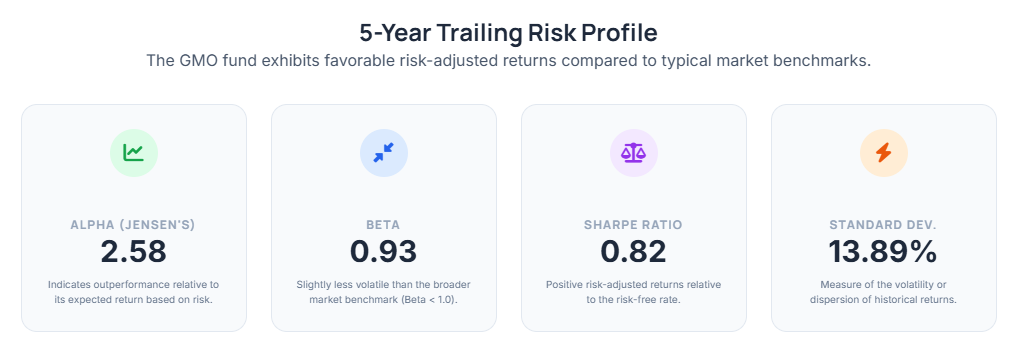
Raw returns tell only part of the story. Risk-adjusted metrics, however, reveal the complete picture. The fund’s Beta of 0.93 over five years shows it moves with the broader market but with roughly 7% less sensitivity to swings. In practice, therefore, the fund loses somewhat less than the overall market during broad sell-offs — a protection that is enormously valuable during sharp, fear-driven drawdowns.
Jensen’s Alpha of 2.58 is statistically significant. Specifically, it shows 2.58 percentage points of annualised return generated purely through manager skill — above and beyond what passive market exposure delivers. Additionally, the Sharpe Ratio of 0.82 indicates strong risk-adjusted compensation. A Sharpe ratio above 0.8 is considered very good for an equity-only strategy. Furthermore, the fund’s Standard Deviation of 13.89% falls below the typical 14–16% for diversified global equity indices. In other words, the fund achieves superior returns not by taking more risk but by concentrating in higher-quality businesses.
Section VI: The Macro Context for International Investing in 2026
The Post-Rate-Hike Environment
Any analysis of the Kotak Overseas Equity Fund must consider the global macro backdrop of early 2026. The global economy navigates a post-rate-hike adjustment phase. The US Federal Reserve raised the federal funds rate from near-zero to over 5% between 2022 and 2023. That was the most aggressive tightening cycle in four decades. Central banks now cautiously ease policy back toward neutral rates. Historically, this transition benefits equity markets. Lower discount rates raise the present value of future corporate cash flows.
Why Quality Companies Benefit Most from Rate Cuts
For global quality companies, the move to lower rates is especially beneficial. These companies tend to have longer-duration earnings profiles due to their predictable, long-term compounding characteristics. The steep rate rises of 2022–2023 disproportionately compressed valuations of high-quality, high-multiple businesses. As that compression reverses, quality stocks stand to recover meaningful relative performance. Furthermore, their strong balance sheets mean they benefit immediately from lower borrowing costs — unlike leveraged businesses that merely survive the shift.
Artificial Intelligence: The Decade’s Defining Tailwind
No analysis of global quality equities in 2026 can ignore artificial intelligence. The commercial deployment of large language models, AI productivity tools, and the infrastructure needed to support them represents the most significant technology investment cycle in decades. Moreover, the companies at the centre of this cycle — Microsoft, Alphabet, Meta, Amazon, TSMC, and Lam Research — are precisely the companies that dominate the GMO portfolio.
Microsoft’s Azure AI platform captures enterprise cloud spending at extraordinary rates. Meanwhile, Alphabet integrates AI deeply into search, advertising, and cloud. Meta, in turn, deploys AI to enhance advertising targeting and builds open-source AI infrastructure through its Llama models. Similarly, TSMC manufactures the advanced chips that power NVIDIA’s AI accelerators, and Lam Research’s etch tools are essential for fabricating those chips. In short, an Indian investor confined to domestic markets has had zero participation in this AI-driven value creation cycle. The Kotak Overseas Equity Fund therefore offers a structured, regulated pathway into what is likely the most consequential technology investment cycle of the twenty-first century.
Why Domestic Portfolios Cannot Replicate This Exposure
The distinction between a domestic Indian equity portfolio and a globally augmented one is not abstract. India’s listed equity markets are dominated by financial services, IT outsourcing, energy, consumer staples, and industrial companies. Notably, India has no listed equivalent of Microsoft, no semiconductor manufacturer at TSMC’s level, no biotech platform of Thermo Fisher’s scope, and no social media platform at Meta’s scale. Furthermore, these gaps will not close in the short or medium term. Building semiconductor manufacturing capacity takes decades. Creating a global internet platform requires network effects built over generations. Consequently, a purely domestic portfolio remains structurally underexposed to some of the most important global wealth-creation drivers of the coming decade.
Discover More About This Fund : Click Here
Section VII: Kotak Overseas Equity Fund NFO — Key Terms and Details
Fund Overview and Key Parameters
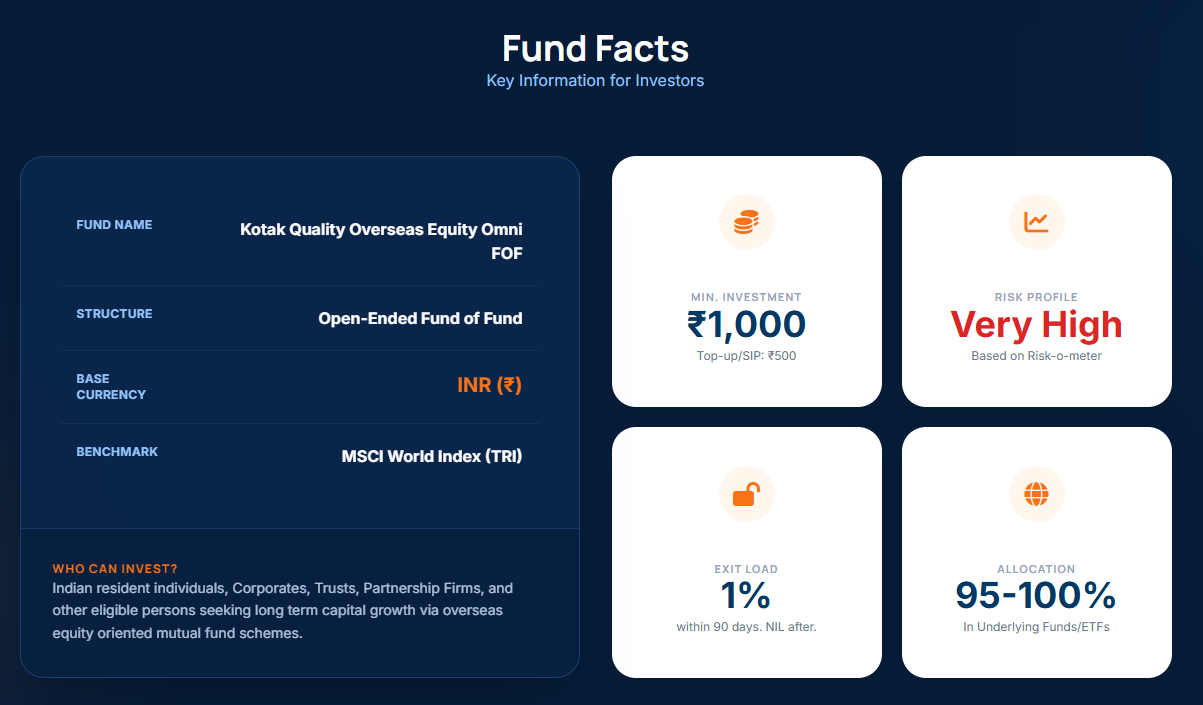
The Kotak Overseas Equity Fund is an open-ended fund of funds scheme. It primarily invests in overseas equity-oriented mutual fund schemes based on the Quality Theme. Here are the key parameters at a glance.
The NFO subscription window opened on March 6, 2026 and closes on March 20, 2026. Investors can review all currently open and upcoming New Fund Offers (NFOs) on GarudVista’s dedicated NFO tracker. The minimum initial investment is ₹1,000. Subsequent investments and SIP instalments start from ₹500. This low entry point deliberately democratises access to global quality investing. An investor with ₹1,000 gains fractional exposure to Microsoft, Apple, and Google through a single fund.
Benchmark, Currency, and Allocation
The fund benchmarks against the MSCI World Index (Total Return Index) — the most widely used global developed equity benchmark, tracking large and mid-cap stocks across 23 developed market countries. The fund’s base currency is INR. All subscriptions and redemptions occur in Indian Rupees. Kotak AMC manages the INR-USD currency conversion internally.
Asset Allocation: The fund allocates 95–100% of its corpus to overseas equity-oriented mutual fund schemes and ETFs. The remainder sits in domestic money market instruments for operational needs. In practice, nearly all assets flow directly into the GMO Quality Investment Fund.
Exit Load and Risk Classification
Exit Load: A charge of 1% applies if you redeem or switch within 90 days of allotment. No exit load applies after that period. This structure attracts long-term investors while giving shorter-term investors the flexibility to exit after three months without permanent penalty.
Risk Classification: The fund carries a Very High risk-o-meter rating. This reflects its concentration in global equities, currency risk, and sector concentration. Take this rating seriously. It is not a formality.
Eligible Investors
The fund is open to Indian resident individuals, Hindu Undivided Families (HUFs), corporate entities, trusts, partnership firms, and other eligible persons under Indian law. NRIs and Persons of Indian Origin should verify their eligibility under current RBI and FEMA guidelines before investing.
Section VIII: Why Choose the Kotak Overseas Equity Fund — Benefits for Indian Investors
Benefit 1 — Access to Companies Not Available Domestically
The most immediate benefit is direct access to world-class companies that do not exist in the domestic investment universe. Every major global technology platform, every leading pharmaceutical innovator, every advanced semiconductor business — all are accessible through this single fund. This is not supplementary diversification. It is entry into an entirely different universe of human enterprise.
Benefit 2 — Reduced Correlation with Indian Market Cycles
Adding a global quality equity allocation historically reduces a portfolio’s correlation with India’s market cycle. When Indian markets experience elevated volatility — as they did in 2008, during the 2013 taper tantrum, the 2016 demonetisation shock, and the 2020 COVID crash — globally diversified portfolios provided meaningful shock absorption. This reduced correlation has real consequences. Specifically, portfolios that avoid catastrophic drawdowns are less likely to trigger the panic selling that permanently destroys long-term wealth.
Benefit 3 — Currency Diversification and INR Depreciation Hedge
The long-term INR depreciation trend of ~3% per annum against the USD creates a structural tailwind for Indian investors in USD-denominated assets. Over a 20-year investment horizon, this compounding effect is substantial. A 14% USD return becomes approximately 17% in INR terms on a historical long-run average basis. Additionally, holding globally denominated assets provides genuine portfolio insurance against sharper INR depreciation — whether driven by a banking crisis, a terms-of-trade shock, or a reversal of capital flows. Investors interested in broader USD exposure may also explore GarudVista’s Dollar Investment options.
Benefit 4 — Participation in Global Innovation Themes
Several of the most important secular growth themes of the coming decade are accessible primarily through global markets. These include the AI infrastructure buildout (TSMC, Microsoft, Alphabet, Lam Research), the transformation of healthcare through precision medicine (Thermo Fisher, Johnson & Johnson), and the globalisation of digital commerce and cloud (Amazon, Accenture). The Kotak Overseas Equity Fund places Indian investors squarely within all of these themes simultaneously.
Benefit 5 — All-Weather Quality Framework
The quality framework has a specific all-weather characteristic. By definition, quality companies generate high returns on capital, maintain strong balance sheets, and grow earnings consistently across multiple business cycles — including recessions, financial crises, and technology disruptions. Therefore, the portfolio is not built for a specific market environment. It is built for all market environments, with a particular tendency toward resilience when lower-quality businesses struggle.
Section IX: The International Mutual Fund Landscape in India
India’s Evolving Interest in Overseas Equity
The Kotak Overseas Equity Fund enters a market that has seen growing — though still limited — retail investor interest in international mutual funds. Following the strong performance of US technology companies through the 2010s, Indian investors began showing greater curiosity about global markets. Several fund houses — Franklin Templeton, Mirae Asset, Nippon India, ICICI Prudential, and Motilal Oswal — subsequently launched international funds and FoF structures. Indian investors have also increasingly explored Exchange Traded Funds (ETFs) as a low-cost complementary route to international exposure. However, the FoF structure typically offers greater accessibility and professional management for retail investors.
The 2022 Regulatory Challenge and Recovery
The category faced a significant challenge in early 2022. SEBI-imposed restrictions on overseas investment limits temporarily prevented existing funds from accepting fresh investments. The industry-wide overseas investment limit had been approached, causing major operational disruption for investors and fund managers alike. Subsequently, SEBI managed these limits more systematically, and the category stabilised. The Kotak Overseas Equity Fund’s launch in March 2026 signals that the regulatory environment now supports orderly international fund launches once more.
What Distinguishes This Fund from Existing Offerings
The competitive landscape for international mutual funds in India is meaningful. A careful investor should understand what sets the Kotak Overseas Equity Fund apart from available alternatives.
First, the underlying manager quality stands out. GMO brings a 45-year history, $7.8 billion in this specific strategy, and a management team whose average tenure at the firm exceeds 28 years. This level of institutional depth and consistency is rare in the international fund space available to Indian investors.
Second, the quality-focused philosophy offers a specific, well-defined investment edge. It is clearly distinguishable from passive index-tracking strategies or broadly diversified global equity funds. The three-pillar quality framework — high profitability, strong balance sheet, stable growth — is not marketing language. It is a systematically applied, quantitatively measured process with a 15-year live track record.
Third, the risk profile of the underlying portfolio is favourable. A beta below 1.0, an above-benchmark Sharpe ratio, and consistent outperformance all suggest that the quality premium is real and persistent. It is not simply a function of luck or a specific market environment. Fourth, the accessibility of the fund is exceptional. With a minimum investment of just ₹1,000 and SIPs from ₹500, it serves retail investors across all income levels — making it a genuinely democratic vehicle for international investing.
Section X: Taxation — What Indian Investors Need to Know
Current Tax Treatment of Overseas FoF Schemes
The taxation of mutual fund returns in India has evolved significantly in recent years. It remains subject to further change. As of the current regulatory framework, Fund of Fund schemes investing in overseas funds receive tax treatment distinct from domestic equity funds.
Capital Gains Tax Rules
Gains from FoF schemes are taxed as capital gains. For units held for more than 24 months, Long-Term Capital Gains (LTCG) apply. For units held for 24 months or less, Short-Term Capital Gains (STCG) apply at the investor’s income tax slab rate. The applicable LTCG rate and indexation treatment may vary based on the latest Finance Act provisions. Investors should therefore verify the current tax treatment with their chartered accountant or tax advisor before investing.
Dividends, DTAA, and Budget Monitoring
The fund operates as a growth-oriented scheme. No dividends are contemplated. All returns accrue through capital appreciation in the NAV. Additionally, the Double Taxation Avoidance Agreement (DTAA) between India and the United States may have implications for dividend and capital gains treatment at the GMO fund level. These effects are typically absorbed within the fund’s NAV rather than generating direct tax obligations for Indian unit holders. Investors should also monitor Union Budget announcements annually. Tax treatment for international FoF schemes has changed before and may change again.
Section XI: Is the Kotak Overseas Equity Fund Right for You?
The Long-Term Wealth Builder
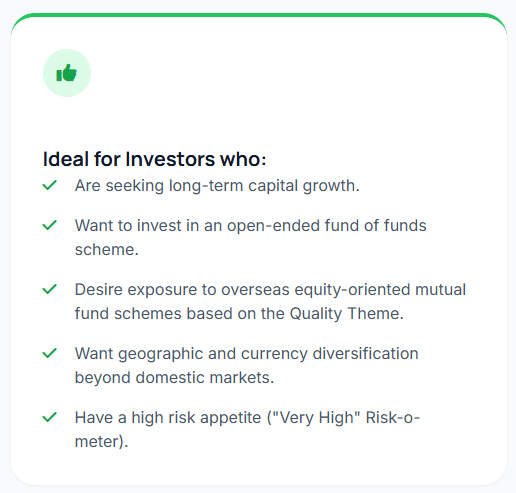
The Kotak Overseas Equity Fund is fundamentally a long-term wealth creation vehicle. It suits investors with a time horizon of five years or more — ideally ten years or longer. Such investors need financial stability and emotional resilience to hold through short-term NAV volatility without panic redeeming. The compounding mathematics of quality investing reward patience disproportionately. The longer the holding period, the more the portfolio benefits from sustained high returns on invested capital.
The Globally Diversified Portfolio Builder
An investor with meaningful domestic equity exposure — through Nifty 50 index funds, large-cap active funds, or multi-cap funds — who recognises the concentration risk of a purely India-centric portfolio is an ideal candidate. The Kotak Overseas Equity Fund can serve as the international equity pillar of a well-constructed long-term portfolio. Furthermore, it complements rather than replaces domestic equity holdings.
The Currency-Aware Investor
Investors with financial goals linked to foreign currencies — international education for children, property purchases abroad, or retirement with USD-linked costs — will find the Kotak Overseas Equity Fund provides a natural long-term hedge. It accumulates USD-denominated wealth while the investor remains based in India.
The AI and Technology Secular Growth Investor
An investor convinced of the multi-decade opportunity in artificial intelligence, cloud computing, semiconductor infrastructure, and digital commerce — but with limited access to the primary beneficiaries through domestic markets — will find GMO’s heavy concentration in exactly these sectors both compelling and practically appropriate.
Conclusion: The Long View on Global Quality Investing
There is a compelling paradox at the heart of the Indian investor’s situation in 2026. India is on a trajectory to become one of the world’s two or three largest economies by mid-century. Indeed, the domestic equity market opportunity remains genuinely compelling. And yet, building a truly resilient long-term portfolio demands acknowledging one simple mathematical reality — 96.6% of the world’s investable equity wealth sits beyond India’s borders.
The Kotak Overseas Equity Fund, backed by GMO’s 15-year track record of disciplined quality investing, offers Indian investors something historically available only to the world’s most sophisticated institutions. Specifically, it provides a concentrated, research-driven allocation to the world’s best businesses — measured by the only criteria that truly matter: high profitability, strong balance sheets, and stable growth.
Moreover, the fund’s portfolio — built around Microsoft’s cloud infrastructure, Alphabet’s AI ecosystem, Meta’s social media dominance, TSMC’s irreplaceable semiconductor manufacturing, and Apple’s consumer platform — represents corporate excellence that generates wealth reliably across decades, not just market cycles.
The Kotak Overseas Equity Fund NFO window is open until March 20, 2026. The minimum investment of ₹1,000 removes the financial barrier entirely. In fact, the only remaining barrier is the willingness to look beyond one’s own borders. In a global economy where the world’s most valuable companies span continents and currencies, a truly global portfolio is no longer a luxury. It is, increasingly, a fundamental requirement of long-term financial resilience.
The world’s best companies are available to Indian investors today. Now, through the Kotak Overseas Equity Fund, the pathway to them has never been simpler.
Disclaimer
Mutual Fund investments are subject to market risks. Please read all scheme-related documents carefully before investing. Past performance may or may not be sustained in the future. This article serves informational and educational purposes only. It does not constitute investment advice or a solicitation to buy or sell any securities. Investors should seek independent professional advice before acting on any information herein. GarudVista Financial Services LLP and its partners accept no liability for investment decisions based on this material. AMFI Registered Mutual Fund Distributor — GarudVista Financial Services LLP (ARN-345364). Currency conversion and return calculations are indicative and based on historical average trends. Actual results may differ materially.
Sources: GMO LLC Factsheet (January 2026), Kotak Mahindra AMC Scheme Information Document, MSCI World Index data, Bloomberg, RBI Annual Report, AMFI data, World Bank Global Financial Development Database.
© 2026 GarudVista Financial Services LLP. All Rights Reserved.